

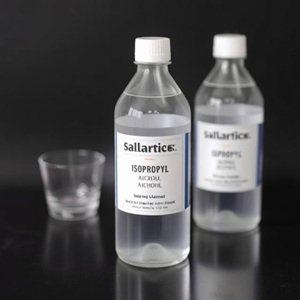
The isopropyl alcohol market was worth about $3.56 billion in 2025 and is projected to hit $5.59 billion by 2035, growing at roughly 4.6% annually. That might not sound explosive, but in the chemical world, that’s steady, structural growth—not a bubble.
The Chip Connection Nobody Talks About
I was honestly shocked when I learned this. TSMC’s Arizona fab alone is a $40 billion investment, and every advanced semiconductor node—from 7nm down to 2nm—requires ultra-high-purity IPA for wafer cleaning. We’re talking 99.9999% purity with metallic contamination below 1 part per billion. One speck of impurity can ruin a $20,000 wafer.
As chips get smaller, they get dirtier in relative terms. Advanced nodes consume 30–40% more solvent per wafer than older ones. So even if total chip production stays flat, IPA demand keeps climbing. SEMI projects 300mm fab capacity to grow 30% between 2024 and 2028. Do the math.
The U.S. CHIPS Act alone represents over $52 billion in committed semiconductor investments. That’s not speculation—that’s purchase orders already flowing to solvent suppliers.
Asia-Pacific dominates this market at 45% share, driven by Taiwan, South Korea, and China’s massive electronics manufacturing bases. But North America is the fastest-growing story because of reshoring.
Download Report Sample Copy with TOC: https://www.marketresearchfuture.com/sample_request/1078
The Supply Side Is More Fragile Than It Looks
Here’s where it gets interesting for anyone thinking about this from an investment or business perspective.
IPA is made from propylene, which comes from oil refining and natural gas processing. When propylene prices swing 25–40% year-over-year—as they did between 2021 and 2024—IPA producers without their own propylene supply get squeezed hard. Margins can evaporate overnight.
The industry is shifting from older “indirect hydration” methods (using sulfuric acid) to direct propylene hydration with advanced catalysts. It’s cleaner, more selective, and uses less energy. Most new capacity is going this route.
But the real disruption on the horizon? Bio-based IPA.
INEOS started producing bio-based IPA in Cologne, Germany in late 2025. Right now it costs 40–60% more than conventional production, so it’s niche. But with EU green hydrogen targets and carbon pricing pressure, that gap could close by the early 2030s. Companies with Scope 3 emissions targets are already asking suppliers for carbon footprints.
The Applications Breakdown (Beyond Hand Sanitizer)
- Process & Preparation Solvents: 46% of the market — This is pharmaceutical manufacturing, where IPA is used to make active pharmaceutical ingredients (APIs). India’s $830 million PLI scheme for bulk drug manufacturing is directly boosting demand here.
- Cleaning & Drying Agents: Fastest-growing segment — Semiconductors, obviously, but also precision electronics and medical device manufacturing.
- Coatings & Dyes: ~$590 million — Low-VOC reformulations are pushing manufacturers toward IPA as a safer solvent alternative.
- Cosmetics & Personal Care: 5.14% CAGR — The “clean beauty” movement ironically increased IPA demand because formulators use it as a natural-feeling preservative and carrier.
The Players and the Power Dynamics
The market is moderately concentrated—top 5 producers hold maybe 38–45% share. The winners tend to be backward-integrated into propylene refining (Shell, ExxonMobil, INEOS, LG Chem). They survive price spikes. Everyone else struggles.
Specialty players like Tokuyama and LCY Chemical dominate the ultra-high-purity electronic-grade niche, charging 3–5x premiums over technical-grade IPA. That’s where the real margins are.
Ask for Customization: https://www.marketresearchfuture.com/ask_for_customize/1078
My Honest Take
I’m not saying IPA is the next lithium or AI chip. It’s a commodity chemical with structural demand tailwinds. But those tailwinds are real:
- Semiconductor fab expansion is government-funded and multi-year
- Healthcare disinfection standards permanently shifted post-COVID
- Pharmaceutical outsourcing to India and China keeps growing
- Green chemistry regulations favor IPA over more toxic alternatives
The risks? Propylene price volatility, ethanol substitution in some disinfection uses, and potential overcapacity from Chinese expansions. But the demand drivers feel more durable than the headwinds.
Related Report
Disclaimer: The iCrowdNewswire provides distribution services for Research Marketing reports, however, it does not assume any responsibility for the content (facts, opinions, photos, or any other part of it) of the reports. All responsibility of the content is with the publisher of the report.
Contact Information:
Contact US
Market Research Future (part of Wantstats Research and Media Private Limited),
99 Hudson Street,5Th Floor New York 10013,
United States of America Sales: +1 628 258 0071 (US) +44 2035 002 764 (UK) Email: Sales@marketresearchfuture.com
Tags:
Research Newswire, English