

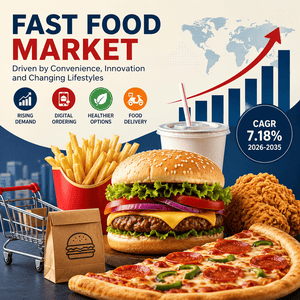
The global fast food industry is undergoing a transformative phase, marked by rapid technological advancements, shifting consumer preferences, and aggressive expansion strategies by leading players. According to insights from fast food industry analysis, the market is projected to grow significantly from USD 1.90 trillion in 2026 to approximately USD 3.52 trillion by 2035, registering a robust CAGR of 7.18% during the forecast period. This growth trajectory is supported by rising urbanization, increasing disposable incomes, and the expansion of dual-income households globally. As consumers continue to prioritize convenience and speed, the fast food sector is evolving into a highly dynamic and innovation-driven marketplace.
Latest Trends Shaping the Fast Food Market
One of the most prominent trends redefining the fast food market is the integration of advanced technologies across operations. Quick service restaurants (QSRs) are increasingly adopting AI-powered ordering systems, self-service kiosks, and cloud-based kitchen management solutions to enhance efficiency and reduce service times. These innovations are significantly improving customer experience and operational productivity, enabling restaurants to cater to high-volume demand with greater precision.
Another key trend is the rising demand for healthier and sustainable menu options. Consumers, particularly millennials and Gen Z, are gravitating toward plant-based alternatives, organic ingredients, and customizable meals. This has led to the introduction of alternative-protein menus and low-calorie offerings, encouraging fast food chains to diversify their product portfolios. Additionally, the growing popularity of ghost kitchens and cloud kitchen ecosystems is reshaping the competitive landscape by reducing overhead costs and enabling delivery-focused business models.
Digital ordering and food delivery platforms have also become integral to the industry. Mobile applications, online ordering systems, and third-party delivery partnerships are driving revenue growth by expanding reach and convenience. The ability to personalize orders and offer seamless digital experiences has become a critical differentiator among leading brands.
Recent Developments in the Fast Food Market
May 2025 – A major global fast food chain revamped its menu by introducing new items while re-launching popular legacy products to align with evolving consumer preferences and increase engagement.
October 2024 – A leading U.S.-based food service brand announced the launch of a modern, compact restaurant concept designed to enhance customer experience and optimize operational efficiency in fast-paced environments.
2023–2025 – Significant investments were made by major industry players in digital transformation initiatives, including AI-enabled drive-through systems, dynamic pricing engines, and predictive supply chain technologies to streamline operations and improve service delivery.
Request for Sample PDF Copy: https://www.marketresearchfuture.com/sample_request/1036
Segment Analysis
The fast food market is segmented based on product type, distribution channel, and service format, each contributing uniquely to overall market growth.
By product type, burgers and sandwiches dominate the market, accounting for over 40% of global revenue due to their widespread popularity and adaptability across regions. Meanwhile, pizza is expected to witness strong growth, supported by its compatibility with digital ordering and delivery-first models. Other segments such as chicken, seafood, and Asian cuisine are also gaining traction, with Asian food emerging as one of the fastest-growing categories due to increasing demand for diverse and flavorful options.
In terms of distribution channels, quick service restaurants (QSRs) hold the largest market share, driven by their efficiency, affordability, and accessibility. Home delivery and online platforms are rapidly expanding, fueled by the proliferation of smartphones and internet penetration. Street vendors and hybrid formats continue to play a significant role, particularly in emerging economies where affordability and convenience are key factors.
From a service perspective, takeaway and delivery models are gaining prominence, while dine-in services continue to evolve with enhanced customer experiences and digital integration. The increasing preference for convenience and time-saving solutions is expected to further accelerate the growth of delivery-centric models.
Regional Analysis
Regionally, Asia-Pacific dominates the fast food market, accounting for approximately 46.5% of global revenue. This dominance is attributed to rapid urbanization, a growing middle-class population, and the expansion of food delivery ecosystems in countries such as China and India. The region’s dynamic consumer base and increasing adoption of Western food culture are driving substantial market growth.
North America remains a mature yet significant market, characterized by high consumption levels and strong presence of established brands. The region continues to lead in technological adoption, including mobile ordering and automated service systems, which enhance operational efficiency and customer satisfaction.
Europe is witnessing steady growth, supported by evolving consumer preferences and the incorporation of healthier menu options. Meanwhile, the Middle East & Africa region is projected to be the fastest-growing market, driven by favorable demographics, increasing investments in the hospitality sector, and rising disposable incomes.
Latin America also presents lucrative opportunities due to expanding urban populations and increasing penetration of international fast food chains.
Top Company Profiles
The fast food market is highly competitive, with a mix of global giants and regional players striving to expand their footprint and enhance customer engagement. Key companies operating in the market include McDonald’s, Yum! Brands Inc., Restaurant Brands International Inc., Domino’s Pizza Inc., Inspire Brands Inc., and Doctor’s Associates Inc.
McDonald’s continues to lead the market with its extensive global presence and focus on digital innovation. The company has invested heavily in AI-driven ordering systems and drive-through enhancements to improve efficiency and customer experience. Yum! Brands, the parent company of KFC, Pizza Hut, and Taco Bell, is expanding aggressively in emerging markets, leveraging localized menus and franchise models to drive growth.
Restaurant Brands International, which owns Burger King and Popeyes, is focusing on menu innovation and digital transformation to remain competitive. Domino’s Pizza has strengthened its position through its robust delivery network and advanced ordering platforms, making it a leader in the pizza segment.
Other notable players such as Inspire Brands and Jack in the Box Inc. are adopting innovative strategies, including menu diversification and strategic partnerships, to capture market share and meet evolving consumer demands.
Conclusion
The global fast food market is poised for substantial growth over the coming decade, driven by technological advancements, changing consumer lifestyles, and expanding global footprints of major players. The increasing demand for convenience, coupled with innovations in digital ordering and delivery systems, is reshaping the industry landscape.
As companies continue to invest in sustainability, menu diversification, and operational efficiency, the market is expected to witness heightened competition and innovation. Emerging markets, particularly in Asia-Pacific and the Middle East & Africa, will play a crucial role in driving future growth, offering significant opportunities for expansion and investment.
Overall, the fast food market represents a dynamic and resilient segment of the global food industry, characterized by continuous evolution and strong growth potential in the years ahead.
Browse More Reports:
Disclaimer: The iCrowdNewswire provides distribution services for Research Marketing reports, however, it does not assume any responsibility for the content (facts, opinions, photos, or any other part of it) of the reports. All responsibility of the content is with the publisher of the report.
Contact Information:
Market Research Future
Email: sales@marketresearchfuture.com
Phone: +1 (855) 661-4441
Tags:
Research Newswire, English