

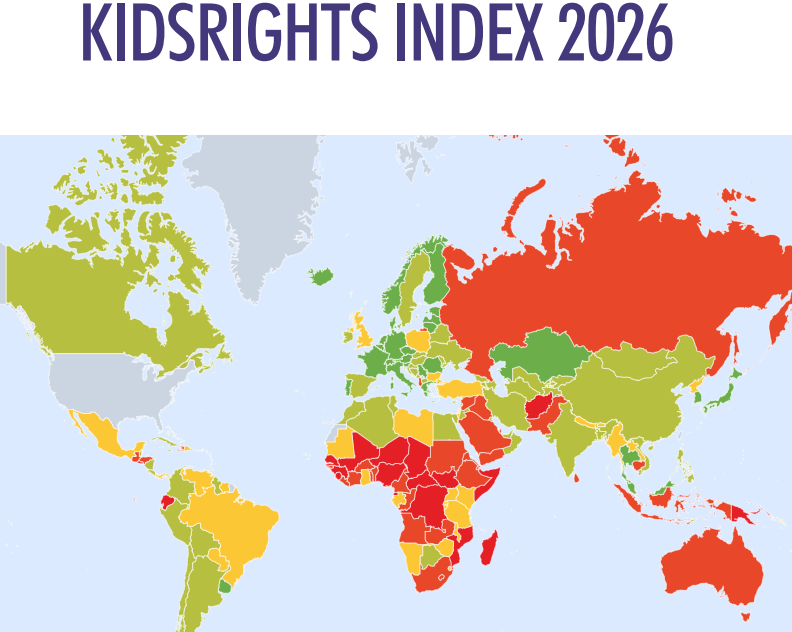
ECUADOR PLUNGES 106 PLACES INTO THE WORLD’S BOTTOM TEN FOR CHILDREN’S RIGHTS
The KidsRights Index, published annually by KidsRights in cooperation with Erasmus University Rotterdam, is the world’s first and only global ranking measuring how countries respect and protect children’s rights and the extent to which they are committed to improving children’s rights.
Key findings from the KidsRights Index 2026:
- Ecuador drops 106 places, from 79th to 185th worldwide.
- The country enters the global bottom ten for children’s rights.
- Ecuador records the steepest decline in Latin America and the Caribbean.
- The fall follows serious concerns raised by the UN Committee on the Rights of the Child over discrimination, child justice and failures to protect children’s rights.
- Ecuador’s score declined on five of the seven indicators used to assess the legal and institutional environment for children’s rights.
14 July 2026 – Ecuador has suffered the steepest decline in Latin America and the Caribbean this year, plunging 106 places into the world’s bottom ten for children’s rights after a critical review by the UN Committee on the Rights of the Child.
According to the KidsRights Index 2026, Ecuador’s overall score fell by 54 per cent. The decline was driven primarily by a collapse in the Enabling Environment for Children’s Rights, where Ecuador fell 111 places to 193rd after receiving the lowest possible score following the Committee’s latest Concluding Observations. Ecuador’s score declined on five of the seven indicators used to assess the legal and institutional environment for children’s rights, reflecting broad concerns about the country’s implementation of the UN Convention on the Rights of the Child.
According to KidsRights, Ecuador’s dramatic decline reflects serious concerns identified by the UN Committee on the Rights of the Child, including structural discrimination against children, shortcomings in the child justice system and legal reforms that weaken the protection of children’s rights.
“Ecuador’s fall is not the result of a single poor score. It reflects deep concerns about whether children’s rights are being adequately protected in law, policy and practice,” said Marc Dullaert, Founder and Chairman of KidsRights. “Those concerns are now impossible to ignore.”
UN warns legal reforms put children’s rights at risk
According to KidsRights, the UN Committee found that Ecuador’s latest reforms weaken children’s rights protections instead of strengthening them.
Among other concerns, the reforms:
- increase pretrial detention for children accused of serious crimes from 90 days to one year;
- raise the maximum prison sentence from eight to fifteen years for crimes committed during internal armed conflict;
- introduce highly restrictive detention conditions for children facing sentences of five years or more.
The Committee also urged Ecuador to better safeguard children’s right to be heard, ensure that the best interests of the child guide all decisions affecting children, strengthen cooperation with civil society organisations and improve legislation to fully comply with the UN Convention on the Rights of the Child.
Ecuador’s decline reflects a broader global child rights crisis
The developments in Ecuador come against the backdrop of a worsening global situation for children. The KidsRights Index 2026 finds that children’s rights worldwide are increasingly under pressure due to armed conflict and growing health challenges.
Across conflict zones worldwide, conflict-related sexual violence against children has increased by 35 per cent since 2024. Children are also increasingly being deliberately targeted and exploited as part of warfare.
The report also identifies a historic global turning point: for the first time, obesity among children and adolescents has become more prevalent than underweight worldwide. In response, the KidsRights Index now includes childhood overweight and obesity as new indicators in its assessment of children’s health.
“Whether it is conflict, discrimination or legislation that weakens children’s protections, children continue to pay the price for decisions made by adults,” said Dullaert. “Governments know what needs to be done. The question is why children are still waiting.”
ENDS
Further information: Saskia.Hartogh@edelman.com
Tel: +31 6 13164413
Editor’s Notes
About KidsRights
KidsRights is an acclaimed international Children’s Rights organisation that strives for a world where all children have access to their rights and are enabled to realise the great potential they carry within them. KidsRights sees children as changemakers with the power to move the world and facilitates them in voicing their opinions and taking action in order to bring about change. KidsRights supports children by commanding global attention for the realisation of children’s rights and acting as a catalyst to ignite change, together with children and youth. KidsRights is the founder of the International Children’s Peace Prize world’s most important youth prize, the world’s first borderless state ‘State of Youth’ and founder/initiative taker of the annual, global KidsRights Index.
Please visit our website to find out more about KidsRights: www.kidsrights.org
About Erasmus School of Economics
Erasmus School of Economics is a leading centre for scientific research and education in economics and econometrics. The activities of this internationally acclaimed School of Erasmus University Rotterdam contribute to understanding current and future economic developments in the world and to answering questions related to the roles of government and business policy.
About the International Institute of Social Studies
The International Institute of Social Studies (ISS) is a graduate school of critical policy-oriented social science. Established in 1952, ISS focuses in particular on research, teaching and public service in the field of development studies and international cooperation. Its students, staff and knowledge partners are both from the Global South and the Global North. Interdisciplinarity and co-creation are among the key features of the work of the Institute. While part of Erasmus University Rotterdam, the ISS is based in The Hague.
About the KidsRights Index
The KidsRights Index has been published annually since 2013 and thus appears in its 14th edition this year. It is the first and only fully comparative worldwide annual index that systematically compares the child rights performance of states that committed to the UN Convention on the Rights of the Child (as of recent 194 or nearly all states in the world).