

The Evolution of the Cybersecurity Insurance Market
The global Cybersecurity Insurance Market is experiencing unprecedented expansion, driven by the rapid digitization of the modern enterprise, the rising frequency of complex cyber threats, and a stringent regulatory landscape worldwide. As organizations shift their critical infrastructure to the cloud and embrace hybrid operational models, their digital attack surfaces have grown exponentially. Cyber risk is no longer categorized merely as an IT concern; it is recognized as a systemic threat to corporate solvency and macroeconomic stability. Consequently, cyber insurance has transitioned from a niche premium offering into an indispensable component of corporate risk management strategy.
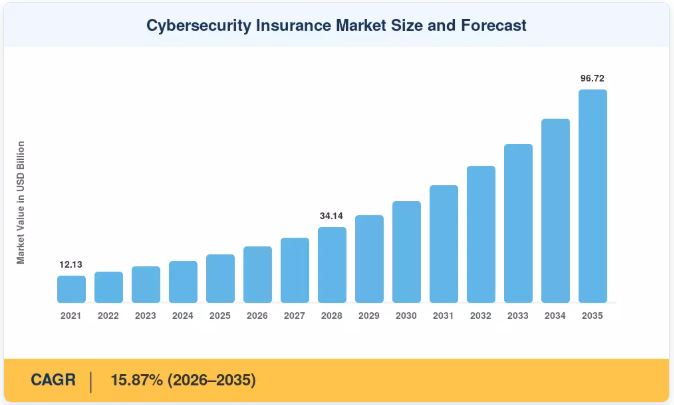
The global Cybersecurity Insurance Market was valued at approximately USD 21.85 billion in 2025 and is projected to grow from USD 25.11 billion in 2026 to USD 96.72 billion by 2035, registering a CAGR of 15.87% during the forecast period. Market growth is being fueled by increasingly stringent cyber-risk disclosure regulations, including the U.S. Securities and Exchange Commission (SEC)’s 2023 incident reporting requirements, which have prompted organizations to strengthen their cyber resilience and expand insurance coverage. As cyber threats become more frequent and sophisticated, cybersecurity insurance is evolving from a supplementary safeguard into a core component of enterprise risk management.
Request To Free Sample of This Strategic Report
https://www.marketresearchfuture.com/sample_request/31718
The Growth Drivers and Dynamics of Cyber Insurance
At its core, Cyber Insurance serves as a financial safety net designed to mitigate losses resulting from cyberattacks, data breaches, and systemic network outages. Unlike traditional commercial policies, cyber insurance is uniquely dynamic. Underwriters must constantly recalibrate their risk models to account for novel attack vectors, such as zero-day exploits, sophisticated business email compromise (BEC) schemes, and double-extraction ransomware campaigns. The market’s growth is further propelled by regulatory mandates, such as Europe’s GDPR and the United States’ SEC cyber disclosure rules, which impose severe financial penalties on organizations that fail to secure customer data or promptly report breaches.
Cyber Liability Insurance: Covering the Fallout
A crucial subset of this market is Cyber Liability Insurance. While first-party cyber coverage handles direct operational impacts (such as data restoration and system repair costs), third-party cyber liability insurance addresses the downstream legal ramifications. If a company suffers a data breach that exposes sensitive consumer information, it faces litigation, class-action lawsuits, regulatory investigations, and contractual penalties. Cyber liability coverage steps in to absorb these legal defense costs, settlements, and regulatory fines. In an era where data privacy is heavily litigated, robust cyber liability protection has become a critical shield for corporate directors and officers.
Strategic Insight: The integration of advanced analytics and real-time scanning tools is shifting the cybersecurity insurance model from passive post-event indemnification to active, continuous risk mitigation.
Technology Infusion: Changing the Underwriting Paradigm
AI In Insurance
Artificial Intelligence (AI) is fundamentally reshaping the actuarial landscape. Historically, underwriters relied on static questionnaires to assess an organization’s security posture. Today, AI in Insurance enables real-time, automated vulnerability scanning and continuous underwriting. By analyzing vast repositories of threat intelligence, machine learning algorithms can predict the likelihood of a breach with remarkable accuracy. Furthermore, AI automates the initial phases of claims processing, detecting fraudulent claims through anomaly detection while dramatically accelerating legitimate payouts.
Blockchain In Insurance
The decentralized nature of ledger technologies offers a powerful solution to trust and verification challenges. Blockchain in Insurance streamlines multi-party transactions and policy verification. Through smart contracts, policies can be executed automatically when pre-defined trigger conditions are met. This is particularly valuable in cyber insurance, where cryptographic verification of a system outage can immediately release business interruption payouts, reducing administrative friction and eliminating protracted legal disputes over coverage parameters.
Buy Now Premium Research Report
https://www.marketresearchfuture.com/checkout?currency=one_user-USD&report_id=31718
Internet Of Things (IoT) Insurance
The proliferation of smart, interconnected devices has created an entirely new risk ecosystem. Internet of Things Insurance addresses the physical-digital convergence. A compromised IoT device in a manufacturing plant or utility grid can lead to physical damage, bodily injury, or catastrophic operational halt. IoT insurance leverages telemetry data directly from smart sensors to adjust premium pricing dynamically. Safe operational habits are rewarded with lower rates, while elevated risk profiles trigger immediate alerts Diversification Across the Insurance Landscape
While cyber risk dominates the modern risk discourse, it intersects with and influences a broad array of traditional and emerging insurance sectors:
Microinsurance: Aimed at low-income individuals and micro-enterprises, microinsurance provides highly targeted, low-cost coverage. As mobile payments and micro-finance platforms expand in emerging markets, microinsurance increasingly incorporates basic cyber protection to safeguard digital wallets and small-scale business data from fraud.
Property Insurance: The line between cyber incidents and physical property damage is blurring. Traditional property policies often exclude “silent cyber” risks—situations where a digital breach causes a physical fire, explosion, or machinery breakdown. Modern property insurers are rewriting policies to clearly define where cyber-physical risks begin and end.
Liability Insurance: Comprehensive general liability policies are being restructured. Insurers are explicitly carving out digital liabilities, forcing corporations to purchase dedicated cyber liability policies rather than relying on standard commercial general liability (CGL) coverage.
Aerospace Insurance: Modern aviation and space assets are highly reliant on complex satellite links, digital navigation networks, and cloud-based logistical systems. Aerospace insurance must now account for state-sponsored GPS jamming, satellite cyber hijacking, and data-link disruptions that threaten aviation safety.
Agricultural Crop Insurance: Precision agriculture relies heavily on GPS-guided tractors, drone monitoring, and automated irrigation systems. Agricultural crop insurance is evolving to cover not just traditional climate-related crop failures, but also the systemic software outages or cyberattacks on smart farm infrastructure that could disrupt planting or harvesting cycles.
Top Key Players in the Cybersecurity Insurance Market
The market is defined by a mix of legacy insurance giants and agile, technology-driven insurtech firms. The leading players driving innovation and underwriting capital include:
AIG: A pioneer in commercial liability and global cyber risk solutions.
Chubb: Known for comprehensive risk engineering and bespoke enterprise policies.
Beazley: A market leader in breach response services and cyber syndicates.
AXA XL: Provides extensive global capacity and deep cybersecurity advisory.
Zurich: Offers integrated corporate risk and business interruption coverage.
Hiscox: Renowned for tailoring cyber policies to small and medium enterprises.
Tokio Marine: Combines international specialty risk expertise with robust Asian market reach.
Munich Re: A primary reinsurance pillar underwriting catastrophic systemic cyber risks.
Coalition: An innovative insurtech combining active monitoring with comprehensive coverage.
Travelers: Offers scalable cyber solutions backed by robust risk-management resources.
Browse In-depth Market Research Report
https://www.marketresearchfuture.com/reports/cybersecurity-insurance-market-31718
Conclusion: The Path Forward
The Cybersecurity Insurance Market is no longer a static transfer of risk; it has become an ecosystem of active security partnership. As underwriting models mature through the adoption of AI, blockchain, and real-time IoT diagnostics, insurers are actively helping organizations build systemic resilience. Businesses that view cyber insurance as an integrated extension of their cybersecurity infrastructure—rather than a mere financial transaction—will be best positioned to navigate the complex, volatile risk landscape of the digital age.
Top Industry Reports from Market Research Future:
Cyber Liability Insurance Market
https://www.marketresearchfuture.com/reports/cyber-liability-insurance-market-35073
Blockchain In Insurance Market
https://www.marketresearchfuture.com/reports/blockchain-insurance-market-7956
Ai In Insurance Market
https://www.marketresearchfuture.com/reports/ai-in-insurance-market-8465
Internet Of Things Insurance Market
https://www.marketresearchfuture.com/reports/internet-of-things-iot-insurance-market-2700
Cyber Insurance Market
https://www.marketresearchfuture.com/reports/cyber-insurance-market-8635
Microinsurance Market
https://www.marketresearchfuture.com/reports/microinsurance-market-11789
Property Insurance Market
https://www.marketresearchfuture.com/reports/property-insurance-market-16204
Liability Insurance Market
https://www.marketresearchfuture.com/reports/liability-insurance-market-16205
Aerospace Insurance Market
https://www.marketresearchfuture.com/reports/aerospace-insurance-market-23909
Agricultural Crop Insurance Market
https://www.marketresearchfuture.com/reports/agricultural-crop-insurance-market-11134
Disclaimer: The iCrowdNewswire provides distribution services for Research Marketing reports, however, it does not assume any responsibility for the content (facts, opinions, photos, or any other part of it) of the reports. All responsibility of the content is with the publisher of the report.
Contact Information:
Market Research Future
99 Hudson Street, 5Th Floor
New York, NY 10013
United States of America
+1 628 258 0071 (US)
+44 2035 002 764 (UK)
Email: sales@marketresearchfuture.com
Website: https://www.marketresearchfuture.com
Tags:
Research Newswire, English